Window & solar panel cleaning on Vashon Island
Island glass doesn't get dirty the way city glass does. Three things are doing it — conifer resin, tree pollen, and salt haze off the sound — and none of the three rinse away in the rain.
What's actually on your windows
1. Conifer resin — and why it isn't "sap"
People call it sap, but what drips off a Douglas fir or a shore pine is resin, and the difference matters. Sap from something like a bigleaf maple is mostly water with a little sugar in it — annoying, but water-soluble. Conifer resin is part of the tree's defense system: thicker, stickier, and full of non-polar compounds like terpenes and resin acids that form a genuine bond with glass.
Worse, it cures. As resin oxidizes it hardens toward a solid, so a spatter that would have wiped off in April can be effectively welded to the pane by August. Left long enough on the same spot, it can leave a haze in the glass surface that no amount of cleaning fully lifts.
This is the single most common reason a Vashon homeowner concludes their windows are "just old." Frequently they aren't old — they have years of cured resin on them.
2. Pollen — the part almost everyone underestimates
Vashon's forest is overwhelmingly conifer. The dominant species across the island are Douglas fir, western hemlock and western red cedar, with shore pine and Pacific madrone mixed in. Conifers are wind-pollinated, which is exactly why their pollen ends up on your house: it is designed to travel through air in enormous volume, not to be carried by insects.
That yellow-green film every spring isn't a nuisance layer that rain removes. It's a sticky organic deposit, and it holds the next round of dust against your glass.
3. Salt haze, if you're near the water
Homes with a view of Puget Sound trade it for airborne salt. Salt is hygroscopic — it pulls moisture out of the air — so a salted pane stays faintly damp, which makes it a better trap for pollen and dust than dry glass. On waterfront homes this is usually the reason glass looks "filmy" rather than spotted.
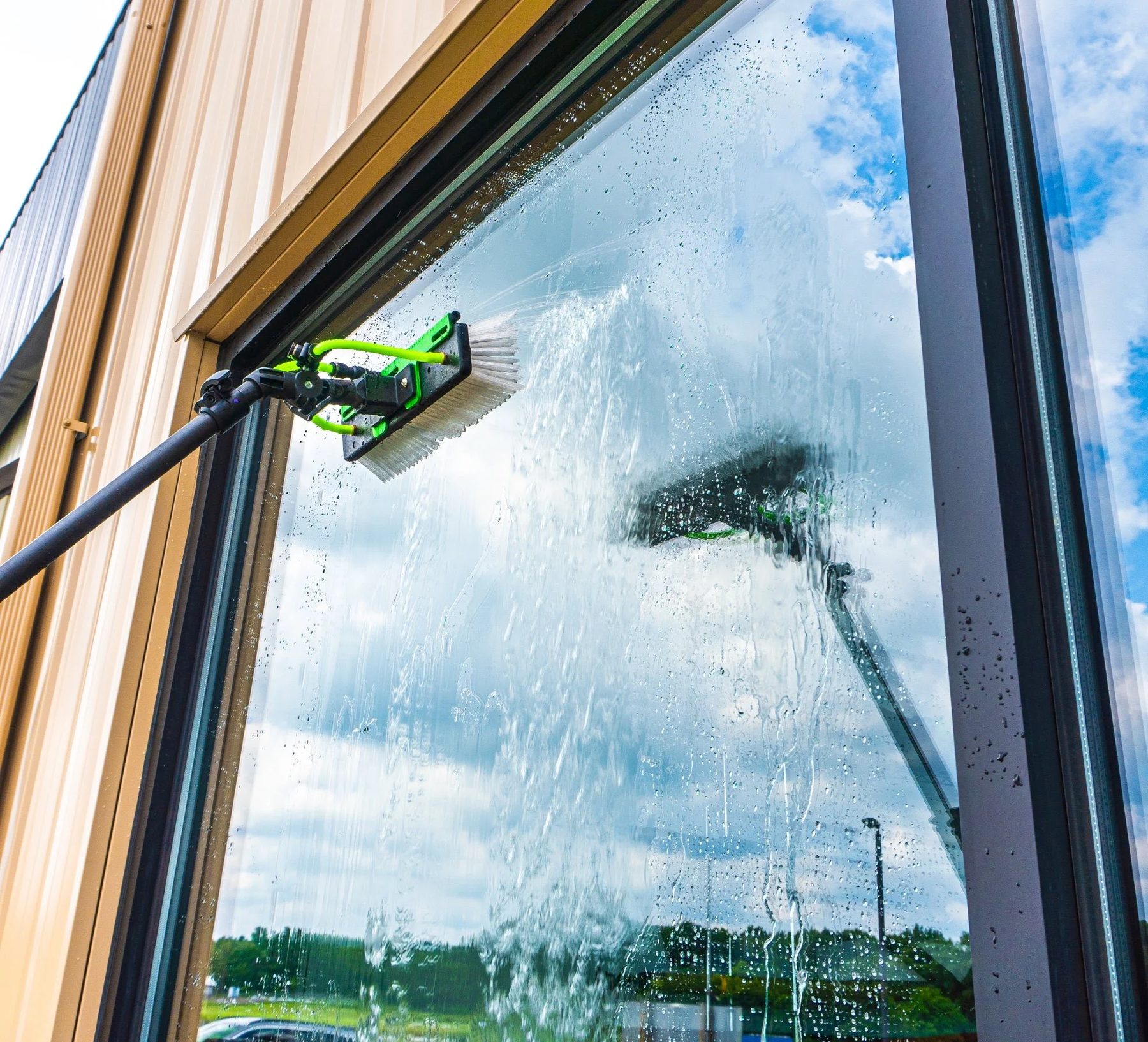
Why purified water matters. Ordinary tap water leaves dissolved minerals behind as it dries — those are the spots. Cleaning with purified water means the water evaporates and leaves nothing, so there's no residue to attract the next layer of pollen. It's also why a proper job stays clean noticeably longer than a hose-and-squeegee job.
Solar panels: rain is not cleaning them
This is the most counterintuitive thing on this page, and it's worth reading twice if you have panels.
A research collaboration led by the U.S. Department of Energy's National Renewable Energy Laboratory — with Duke University, the University of Jaén and Sapienza University of Rome — studied pollen-driven soiling at five solar facilities. Their findings:
What the researchers found
- Tree pollen reduced panel performance by more than 15%.
- Recovery after pollen season was slow, over months, and showed no correlation with rainfall.
- Pollen from cypress, juniper, pine and oak was particularly stubborn about sticking to panel glass.
- Manual cleaning after rain still improved output by a further 5–11% — meaning the rain had left real losses on the table.
An honest caveat: that study was conducted in North Carolina, not Puget Sound, so don't read the exact percentages as a prediction for your roof. What transfers is the mechanism — conifer pollen bonds to panel glass and rain does not clear it. Vashon is a conifer-dominated island with about 40 inches of annual rainfall, which means we have abundant supply of the pollen and abundant evidence that the rain isn't solving it.
If your panels are under fir cover, add needle litter, resin spotting and shade-driven grime to the same picture. Every one of those is output you paid for and aren't collecting.
How often, realistically
Not a sales answer — the honest ranges for this island:
Windows
Twice a year suits most Vashon homes: once after the spring pollen drop (usually late May into June, once the worst of the conifer pollen has fallen) and once in early autumn, before the wet season sets in and you stop wanting to look through them. Homes tucked directly under fir or cedar, or right on the water, are usually better on three.
Solar panels
Once or twice a year, with the more valuable visit being right after pollen season — that's when the measured losses are largest and when rain is demonstrably not going to fix it for you. If your array is under trees, twice.
One thing worth not doing: pressure washing your own windows or panels. High pressure drives water past window seals and into the frame, and on solar panels it risks both the anti-reflective coating and the perimeter seals. Panels get purified water and soft equipment, nothing more aggressive.
Common questions
How often should windows be cleaned on Vashon Island?
Most homes do well on twice a year — after the spring pollen drop and again in early autumn. Homes under direct fir or cedar cover, or on the waterfront where salt haze is a factor, often want three visits.
Doesn't rain clean my solar panels?
Not reliably. NREL-led research found tree pollen cut output by more than 15%, and that recovery afterward was slow with no correlation to rainfall. Rain rinses loose dust; it does not remove bonded pollen or cured resin.
Why won't the sap come off my windows?
Because it's resin, not sap. Conifer resin bonds chemically to glass and hardens as it oxidizes, so it gets more stubborn the longer it sits. Water alone won't move it.
Do you do inside as well as outside?
Yes — just say so when you get your quote so the time is accounted for.
Can you reach second-story windows?
Yes. A water-fed pole reaches upper-story glass from the ground, which is both safer and less disruptive than ladder work around your landscaping.
Related
If you have conifers over your house, the same trees are feeding two other problems: moss on your roof and needle litter in your gutters.