Roof moss removal on Vashon — done the way shingle makers actually recommend
Moss on a Puget Sound roof isn't a cosmetic complaint. It lifts the edges of your shingles, holds water against them, and routes rain sideways underneath instead of down and off. Here's the mechanism, and why the fastest-looking way to remove it is the one that ruins roofs.
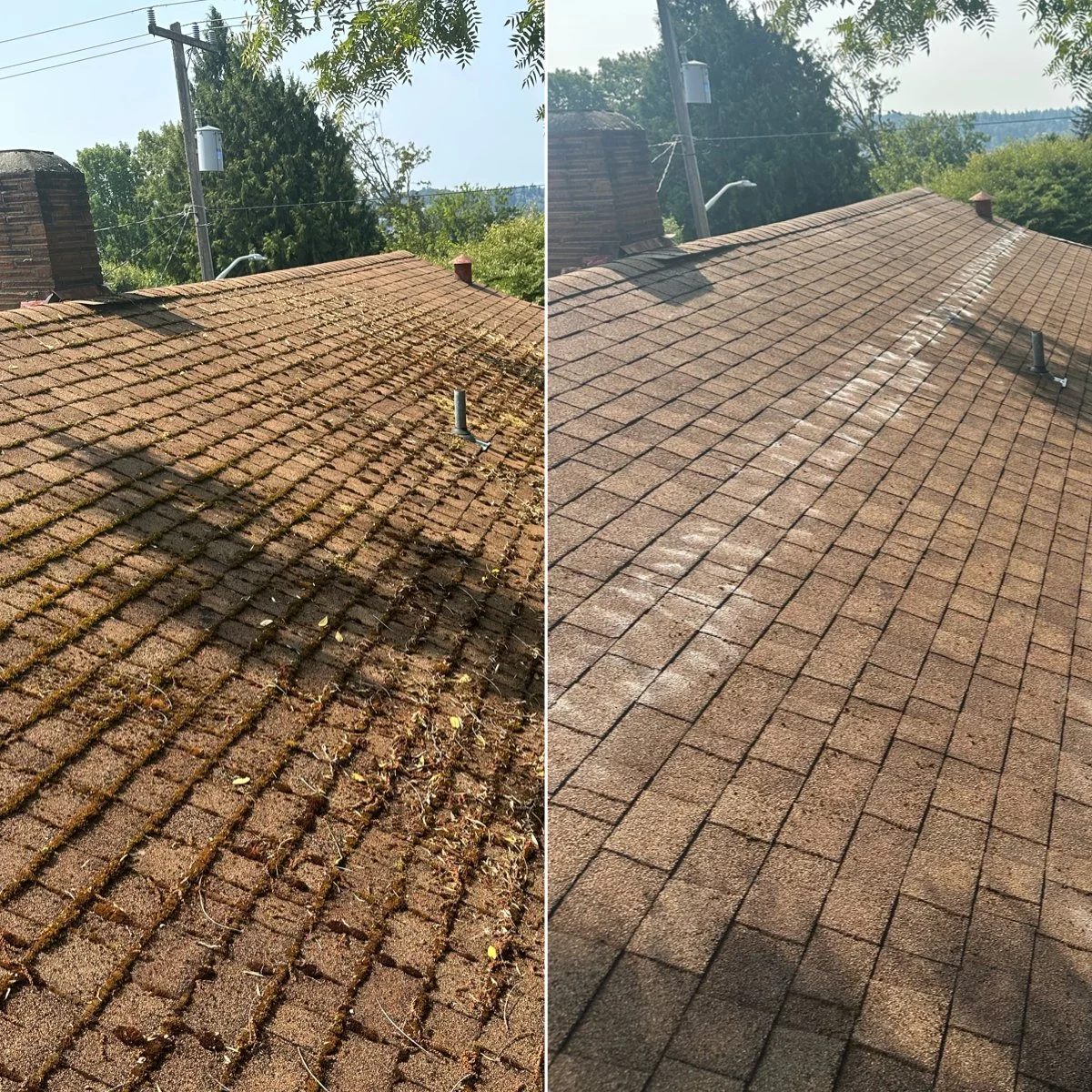
What moss actually does to shingles
Moss doesn't have true roots, but it does have root-like structures called rhizoids that work their way into and under the edges of shingles to anchor. That anchoring is where the damage starts.
The Asphalt Roofing Manufacturers Association — the trade body for the companies that actually make asphalt shingles — puts the two failure modes plainly:
"Moss can cause the leading edges of the shingles to lift or curl, which increases the risk of shingle blow-off during wind events."
"Moss build-up can cause lateral water movement resulting in moisture damage to the roof deck or may even cause leaks."
— Asphalt Roofing Manufacturers Association, guidance on algae and moss cleaning for asphalt roofing systems
Read those two together and you have the whole problem. A shingle roof works because water can only ever travel down it, shedding from one overlapping course to the next. Moss breaks that in both directions at once: it pries the overlaps open, and it gives water a path to move across the roof under the shingles instead of over them. Wind then has an edge to grab.
The sponge effect
Then there's simple moisture. A moss mat behaves like a sponge sitting on your roof — it holds rain long after the surrounding shingles have dried. That prolonged wetness works on the asphalt binder and accelerates the loss of the protective granule layer. On the rare Vashon nights that dip below freezing, water trapped in that mat expands and contracts, working at the shingle from the surface in.
Why Vashon is close to a worst case
Moss needs moisture, shade, and mild temperatures. This island supplies all three, year-round:
The conditions here
- Water: roughly 40 inches of rain a year, spread across about 150 days with some precipitation — and no meaningfully dry season to reset things.
- Mild marine climate: winters that are wet rather than hard-frozen, so moss is never really killed back the way it is in a continental climate.
- Shade and debris: Douglas fir, western hemlock and western red cedar dominate the island's forest. Overhanging conifers shade roof planes and drop needle litter, and that litter holds moisture exactly where you don't want it held.
Moss establishes first on north-facing roof planes, which get the least direct sun and stay damp longest. If you want to know how bad your own roof is, that's the slope to look at — and the one under the most tree cover.
The pressure washing question
A pressure washer strips moss off a roof fast, and it looks impressive doing it. It is also, according to the people who manufacture the shingles, a way to destroy the roof:
"Never use a pressure washer to clean an asphalt shingle roof as this will cause granule loss and very likely premature failure of the roof system."
— Asphalt Roofing Manufacturers Association
Those granules are not decoration. The mineral granule layer is the shingle's UV shield — it's what stops sunlight breaking down the asphalt underneath. Blast the granules off and you get a roof that looks clean this afternoon and ages years in the following summers. The bare patches typically show up as accelerated wear long after the person who caused it has been paid.
ARMA's recommended approach instead is chemical, not mechanical: a diluted chlorine bleach solution applied with a sprayer, allowed to dwell 15–20 minutes, then rinsed with low pressure water. That's the method we use — treat, let the treatment do the work, rinse gently, and let the dead moss weather off over the following weeks.
It's slower. It's also the difference between cleaning a roof and shortening its life. This is the specific thing Russell means about setting the business apart from services that, in his words, "rarely have any regard for preserving shingles and roofing materials."
What to ask anyone quoting your roof: "are you pressure washing it?" If the answer is yes, and it's asphalt shingle, you now know what the manufacturers' own association says about that.
How often
For most Vashon roofs, every two to three years keeps moss from ever getting established enough to lift shingle edges. Under heavy conifer cover — especially a north-facing plane beneath firs — annually is more realistic.
The economics favour staying ahead of it. Treating a light bloom is a straightforward visit. Removing an established mat is more work, and by then the rhizoids have already spent a few winters under your shingle edges.
Common questions
Is moss actually damaging my roof, or does it just look bad?
It's genuinely damaging. ARMA — the asphalt shingle manufacturers' association — says moss lifts and curls shingle edges (raising wind blow-off risk) and causes lateral water movement that can damage the roof deck or cause leaks.
Can you just pressure wash it off?
No, not on asphalt shingles. ARMA's instruction is explicit: never pressure wash an asphalt shingle roof, because it causes granule loss and very likely premature roof failure. We treat and rinse at low pressure instead.
Why is the moss only on one side of my roof?
Almost always the north-facing plane, because it gets the least sun and stays damp longest. Tree cover on that side makes it worse.
Will the moss disappear the same day?
The treatment kills it that day, but dead moss weathers off gradually over following weeks of rain rather than vanishing immediately. That gradual release is a feature of not blasting your granules off.
Do you clean the gutters at the same time?
It usually makes sense to — roof debris ends up in the gutters, so doing both in one visit avoids paying for two trips. See gutter cleaning.
Related
The same conifers shading your roof are filling your gutters with needle litter. And if you're wondering where a pressure washer is the right tool, that's driveways, siding and decks.